
Pule Temple Chengde Guide: Xuguang Pavilion, Terrace Views and Visit Planning
Pule Temple offers a different way to look at Chengde: through a circular roof above a stone platform, a richly decorated ceiling, and terraces that connect the architecture with the surrounding hills. Its main building, Xuguang Pavilion, is the reason to come. Rather than adding another large complex to an already crowded itinerary, allow time to study how this one temple changes as you move from the entrance to its upper levels.
For most first-time visitors, 60–90 minutes inside the temple is a useful planning allowance, with extra time for transport and photography. This is our suggested pace, not an official tour duration. Pule works well as a focused stop on a longer Chengde visit, especially if you have already set aside proper time for the Mountain Resort.
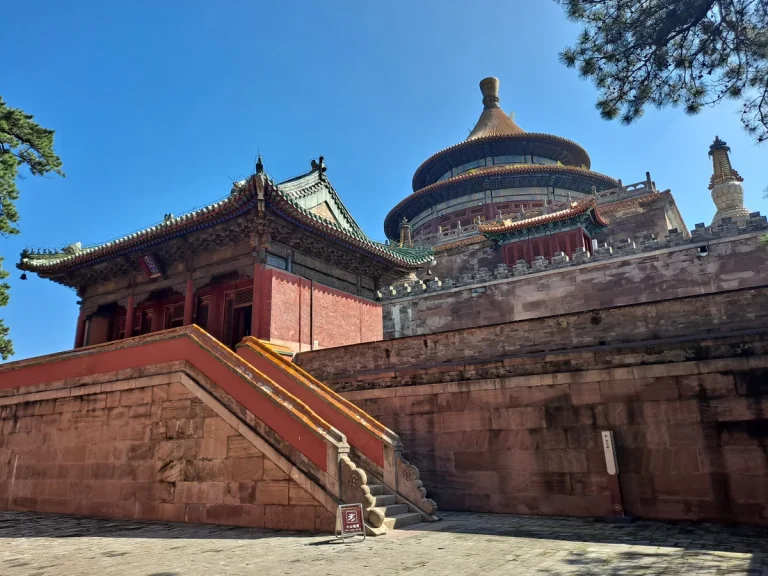
Pule is not Puning: save the Chinese name
Use 普乐寺 for Pule Temple and 旭光阁 for Xuguang Pavilion. Pule lies east of the Mountain Resort, on the eastern side of the Wulie River, in the Qingchuifeng scenic area. The name is easily confused with 普宁寺, Puning Temple, which is a different attraction with its celebrated large Guanyin statue.
Show the full Chinese name and map pin to your driver. If the giant wooden Guanyin is your priority, use our Puning Temple guide instead. If the circular pavilion and its architectural details caught your eye, you are looking for Pule. Buying a ticket or arranging transport for one does not automatically cover the other.
What makes the architecture distinctive?
Pule was founded in 1766 during the Qianlong reign. Chengde’s heritage authorities describe its layout as a combination of Han Chinese and Tibetan architectural traditions, arranged on rising ground facing west toward the Mountain Resort. It belongs to the wider imperial-temple landscape around the resort, rather than being a building inside the palace gardens.
The visual change is the rewarding part of the visit. At the entrance, red walls and conventional rooflines establish a familiar courtyard-temple scale. Higher up, the broad masonry platform gives Xuguang Pavilion a very different presence. The circular, double-eaved roof is often compared with Beijing’s Hall of Prayer for Good Harvests, but a resemblance in silhouette does not make the two buildings identical in purpose or religious meaning.
UNESCO’s account of Chengde emphasizes the relationship between the resort, its outlying temples and the natural terrain, as well as the combination of architectural traditions. Keep that landscape in mind here: the view across rooftops and wooded slopes is part of understanding the setting, not simply a bonus photograph after the building.
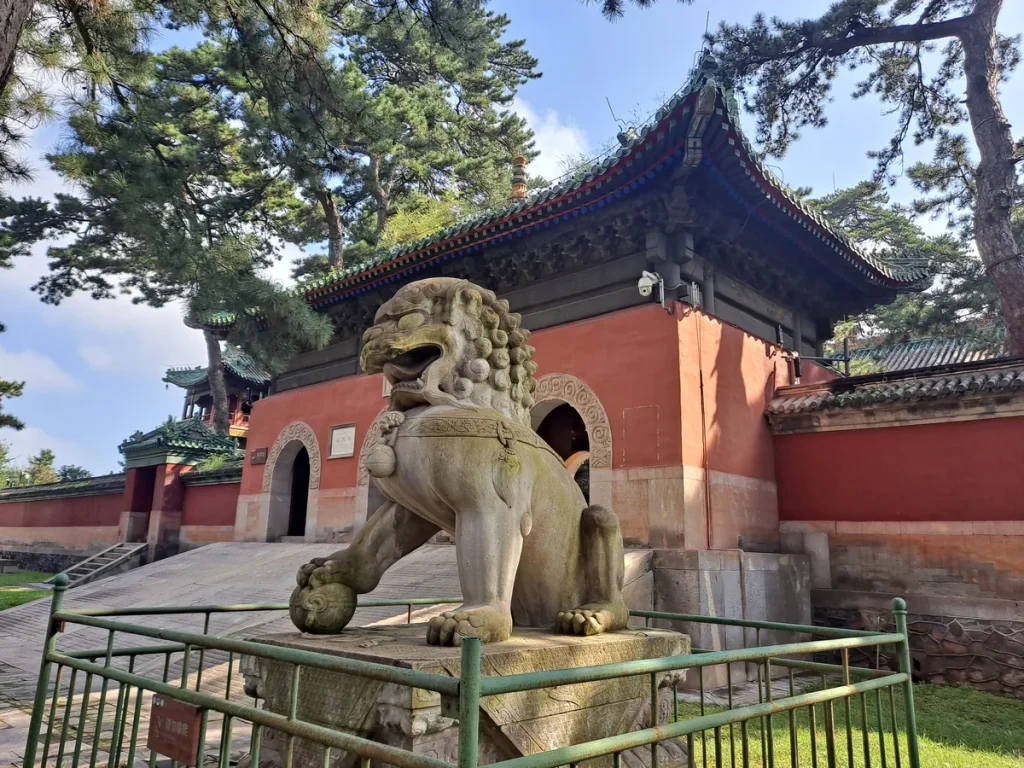
A simple visit sequence
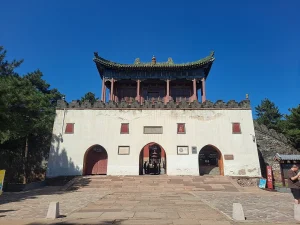
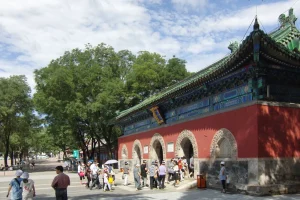
- Entrance and lower courtyards: 15–20 minutes. Start with the gate, guardian sculpture and tree-lined spaces. Notice the proportions of the lower buildings before moving uphill. Read the current site notices here, especially any restrictions on halls or access routes.
- Terraces and pavilion exterior: 20–30 minutes. Follow the permitted route upward. From below, compare the straight edges of the stone platform with the curves of the pavilion roof. From nearer the building, look at the tiled eaves, painted woodwork and the way the structure sits on its raised base.
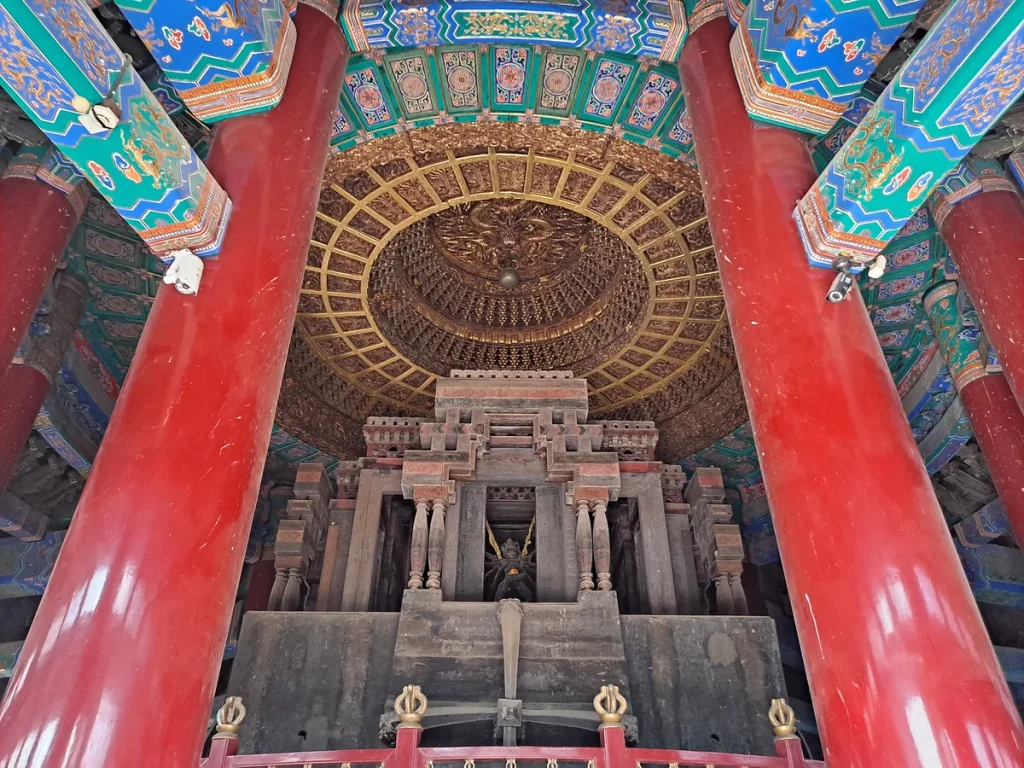
- Interior, when open: 15–20 minutes. Give your eyes time to adjust, then look upward at the caisson ceiling and across the painted beams. Follow staff instructions rather than treating an online photograph as permission to enter or photograph every area.
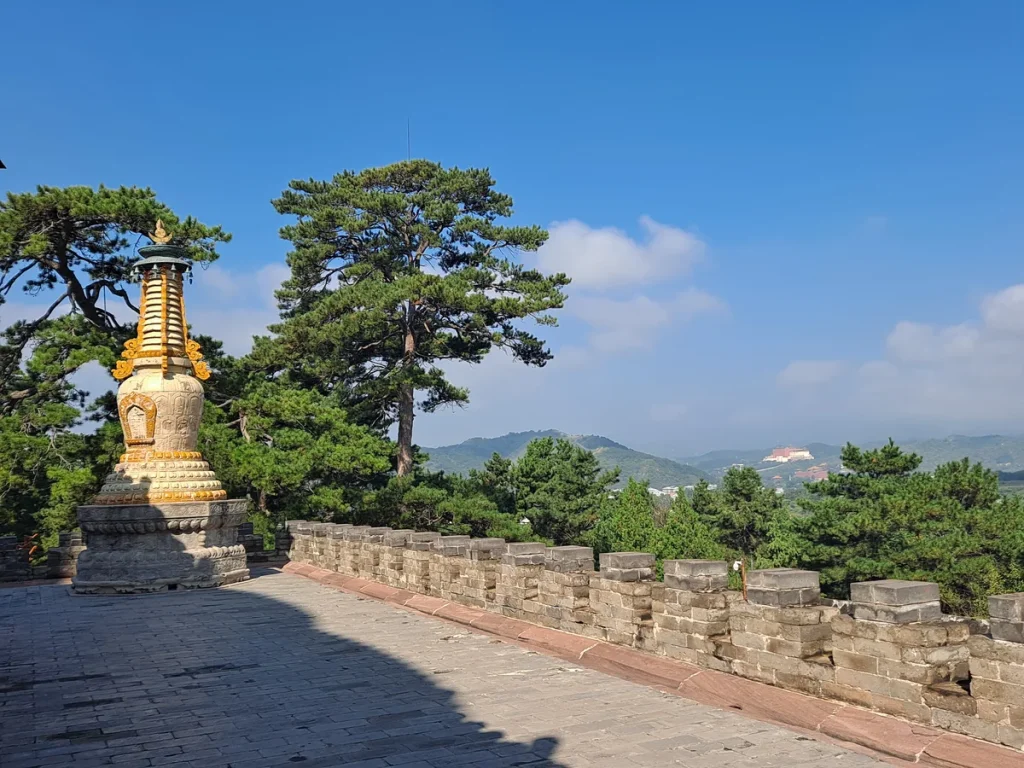
- Terrace view and return: 10–20 minutes. Pause at an open, permitted viewpoint, then allow time to descend without rushing. These estimates overlap slightly and should be shortened or extended according to access and your interests.
You do not need to identify every religious figure to appreciate the visit. A useful first pass is to observe three things: the geometry of the platform and pavilion, the contrast between stone and painted timber, and the relationship between the buildings and the hills.
Inside Xuguang Pavilion: look up, then slow down
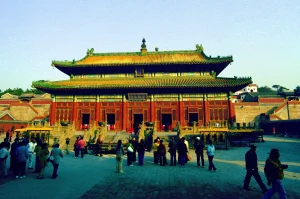
The official tourism description highlights a circular caisson ceiling with dragon decoration and the pavilion’s Tibetan Buddhist setting. The photograph below shows the richly patterned ceiling, red columns and central shrine arrangement. Take these as separate layers rather than trying to absorb everything at once: the broad ring overhead, the painted beam surfaces, then the shrine beneath.
Religious imagery here is not interchangeable with the Guanyin at Puning Temple. Use the site’s interpretation or a knowledgeable guide for specific iconography, and avoid reducing unfamiliar imagery to a novelty. Do not touch carvings, painted surfaces or shrine fittings. Keep flash off, and put the camera away wherever photography is restricted.
Opening hours, tickets and conservation checks
Information reviewed on 17 September 2026: the most recent general opening-hours notice located for this guide is Chengde’s 21 May 2025 announcement. It lists Pule Temple as opening at 08:00, with ticket sales ending at 17:00, last admission at 17:10 and closure at 18:00. Treat this as a published reference schedule, not a same-day guarantee; seasonal notices can replace it.
A municipal notice dated 12 November 2025 lists a RMB 30 adult ticket for Pule Temple in the low season. That figure should not be used as a confirmed September price. The same notice distinguishes Pule, Anyuan Temple, Qingchuifeng Forest Park and a broader Qingchuifeng scenic-area ticket. Ask exactly which places your chosen ticket covers, whether it is date-specific, and whether any cableway fare is separate.
There is also a conservation point worth checking before making a special journey for the interior: a 2026 official project document describes completion and acceptance work for Pule Temple’s historic decorative-painting conservation project. A budget document is not a closure announcement and does not establish which halls are currently accessible. Ask whether Xuguang Pavilion’s interior and upper terrace are open for your intended date.
Useful questions to show at the ticket office are 今天旭光阁内部开放吗? (“Is the interior of Xuguang Pavilion open today?”) and 这张票包含哪些景点? (“Which attractions does this ticket include?”). Foreign visitors should bring their passport and confirm the accepted booking or ticket-collection method rather than assuming a domestic-ID-only form is the only option.
How to fit Pule into a Chengde trip
With the Mountain Resort: put the resort in its own substantial time block, then choose Pule for another morning or a shorter afternoon. Do not plan on seeing the entire resort and several outlying temples in a single hurried day. The two-day Chengde itinerary gives you a more workable framework.
With Qingchuifeng: consider the mountain separately from the temple visit. They share the wider scenic area, but a temple walk is not the same as a hill route. Check access points, weather, walking demands and any cableway operation before committing. A combined ticket does not reduce the physical effort or the time needed between stops.
With another temple: choose a contrast, not a checklist. The Putuo Zongcheng Temple guide covers a very different large-scale architectural experience. Compare that with Pule’s circular pavilion and decide which deserves more time. Both are separate destinations, not neighbouring halls on one continuous visitor route.
Arriving by rail still leaves a city transfer. Use the Beijing–Chengde train guide for station planning, then arrange the last leg to the temple itself. Save your hotel address and a return pickup point offline. This guide does not quote a fixed taxi fare or a bus number that has not been checked for the current service.
Photography and accessibility
For an overall picture, include some of the stone base beneath Xuguang Pavilion rather than cropping the building to its roof alone. At the lower entrance, the trees and red walls give a different sense of scale. On the terrace, use the balustrade and a glazed stupa to frame the landscape without leaning over a barrier or stepping into a closed area.
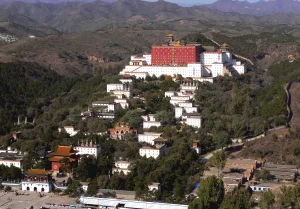
The four images here are real photographs taken on 1 September 2025. They illustrate architectural features, not today’s weather, crowd levels or access arrangements. All carry individual source and license links. Present-day conservation work may change the view.
The photographed route includes steps and raised terraces. Do not assume the full circuit is wheelchair-accessible; ask about step-free entry, reachable viewing points and assistance before travelling. Shoes with grip are sensible, especially after rain. If climbing is difficult, decide whether the accessible lower areas would still justify the trip before purchasing admission.
Official references
- Chengde government: Pule Temple’s founding, orientation and conservation background.
- Beijing official tourism directory: Pule Temple and Xuguang Pavilion architecture.
- UNESCO: Mountain Resort and its Outlying Temples, Chengde.
- Chengde government: May 2025 opening-hours announcement.
- Chengde government: November 2025 low-season ticket prices.
- Official 2026 project document: Pule Temple decorative-painting conservation.
Visit durations and itinerary suggestions are editorial estimates. Confirm current admission, accessible areas and transport before departure.
Xumi Fushou Temple Chengde Guide: Great Red Terrace, Panchen Lama History and Respectful Visits
Plan a thoughtful Xumi Fushou Temple visit in Chengde: Great Red Terrace architecture, historical context, nearby Outer Temples,…
Puning Temple Chengde Guide: Big Buddha Temple, Guanyin Statue and Outer Temple Route
Plan Puning Temple in Chengde with Big Buddha Temple context, the giant wooden Guanyin statue, route timing, transport,…
Putuo Zongcheng Temple Chengde Guide: Little Potala Palace, Route and Visitor Tips
Plan Putuo Zongcheng Temple in Chengde with Little Potala Palace context, route timing, photo viewpoints, outer temple links,…
Chengde Puning Temple and Putuo Zongcheng Temple Guide
Plan a Chengde Outer Temples day with Puning Temple, Putuo Zongcheng Temple, Mountain Resort pairing, route timing, tickets,…
Mulan Paddock Weichang Guide: Grasslands, Yudaokou and Saihanba Route
Plan a thoughtful Mulan Paddock trip in Weichang: grassland and forest landscapes, Yudaokou and Saihanba route logic, seasonal…
Wulingshan National Nature Reserve Guide: Xinglong Forest Trails and Visitor Planning
Plan a Wulingshan visit in Xinglong with forest-and-waterfall context, reserve-minded hiking advice, current-access checks, and practical links for…