
Tangshan Earthquake Memorial Park Guide: Museum, Memorial Wall and 1976 Ruins
Tangshan Earthquake Memorial Park is not a conventional sightseeing stop. It brings together a wall of names, surviving industrial ruins and a museum that explains the 1976 earthquake and the city’s reconstruction. Visit slowly, keep the tone respectful, and leave enough time to absorb the outdoor spaces before moving into the exhibition.
For most independent visitors, 90 minutes to 2.5 hours is a useful allowance for the park and museum, depending on exhibition access and how much you read. This is an editorial planning estimate, not an official visit duration. If the museum is closed or limiting entry, the memorial wall and preserved ruins still require a thoughtful visit, but check which outdoor areas are accessible that day.
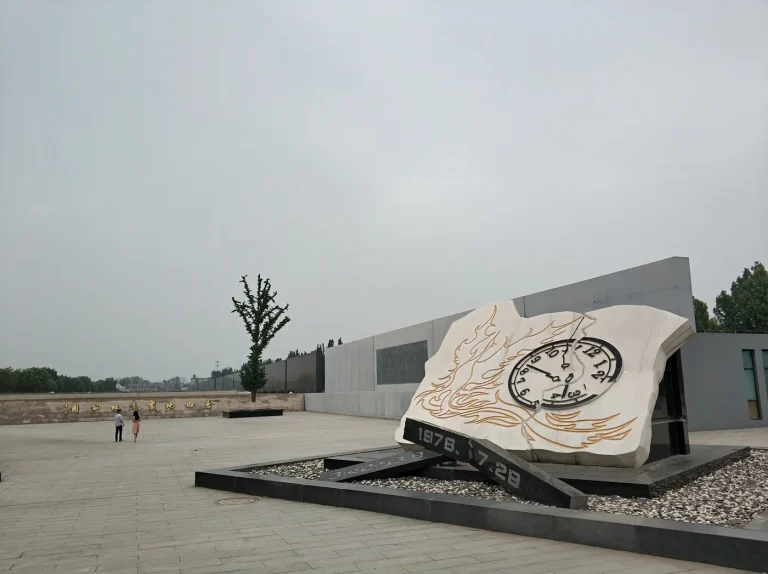
First, use the correct Chinese name
Save 唐山地震遗址纪念公园 for Tangshan Earthquake Memorial Park and 中国·唐山地震博物馆纪念展馆 for the memorial exhibition hall inside it. The park is in Lunan District, on the site associated with the former Tangshan rolling-stock works. It is separate from the 唐山抗震纪念馆, or Tangshan Anti-earthquake Memorial Hall, near the downtown earthquake monument.
The two institutions cover related history but are not interchangeable map pins. A taxi driver, hotel receptionist or map app may understand “earthquake museum” in more than one way. Show the full Chinese name and check the destination before departure. This guide is about the memorial park, its museum, wall and industrial ruins.
What changed in 2026?
Information reviewed on 18 September 2026: an announcement issued by the park’s management center states that the memorial exhibition hall began trial operation on 26 July 2026. The announcement listed Tuesday–Sunday opening from 09:00 to 17:00, summer last admission at 16:30, free entry and no reservation requirement. It also warned that visitor numbers could be limited during busy periods.
Because this was explicitly a trial-operation notice, do not treat it as a permanent timetable for every season or holiday. Confirm the current museum status, last admission, identity-document requirements and any temporary closure before a special journey. The surrounding park and the indoor exhibition may follow different access arrangements.
Foreign visitors should carry their passport. The July notice did not say that foreign visitors need to book, but an “open without reservation” announcement does not eliminate security checks or capacity controls. Useful questions are 纪念展馆今天开放吗? (“Is the memorial exhibition hall open today?”) and 外国护照可以直接入馆吗? (“Can I enter directly with a foreign passport?”).
A respectful route through the park
1. Begin with the open plaza and orientation
Pause near the entrance before moving straight to the main sights. Establish where the museum, memorial wall and preserved factory ruins sit in relation to one another. If a current map or staff route is provided, follow it: construction, formal ceremonies or crowd management can change the most sensible walking order.
Read the introductory interpretation before taking detailed photographs. This is a memorial landscape, so a wide establishing picture is more appropriate than treating the entrance sculpture as a backdrop for playful poses. Keep pathways open for families, school groups and mourners.
2. Walk the memorial wall without rushing
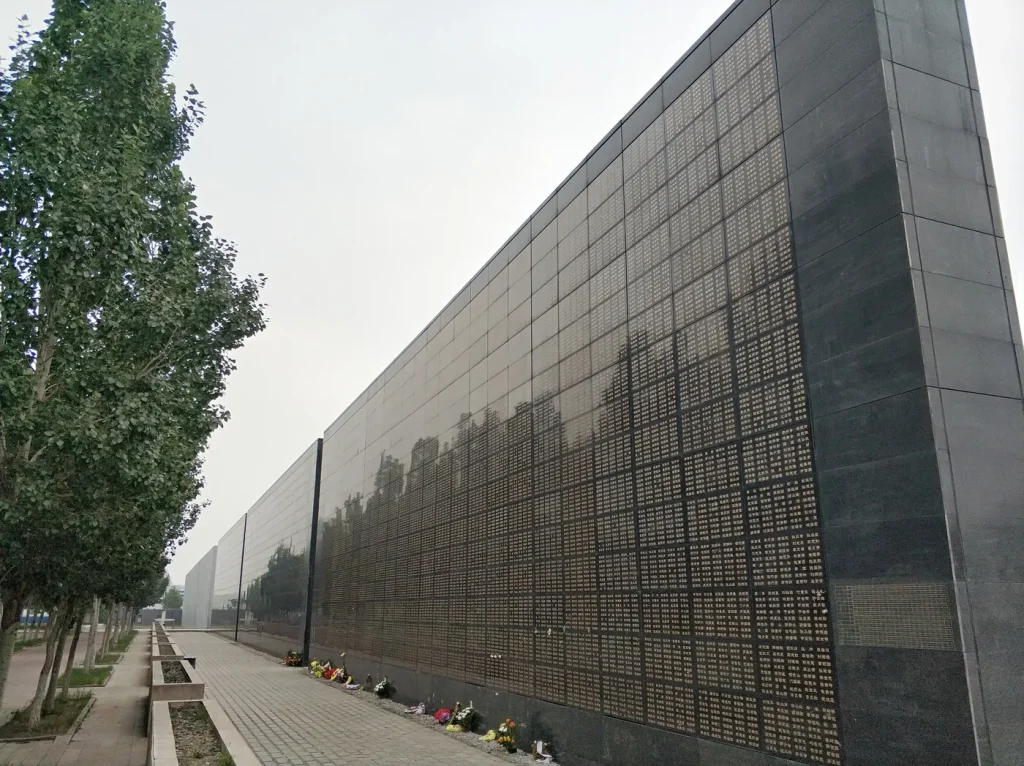
The wall consists of multiple long sections engraved with names. Tangshan municipal reporting in 2022 described five groups and 13 wall faces; the wall height of 7.28 meters and the 19.76-meter-wide memorial avenue encode the date 28 July 1976. The same report said the wall then recorded 247,574 earthquake victims and people who died during rescue work.
Numbers alone cannot convey what the wall is for. Stand far enough back to understand its scale, then move closer to see that the surface is composed of individual names. Flowers may have been placed by relatives or visitors. Do not move them, lean equipment against the wall or block someone who is searching for a name.
3. Continue to the preserved industrial ruins
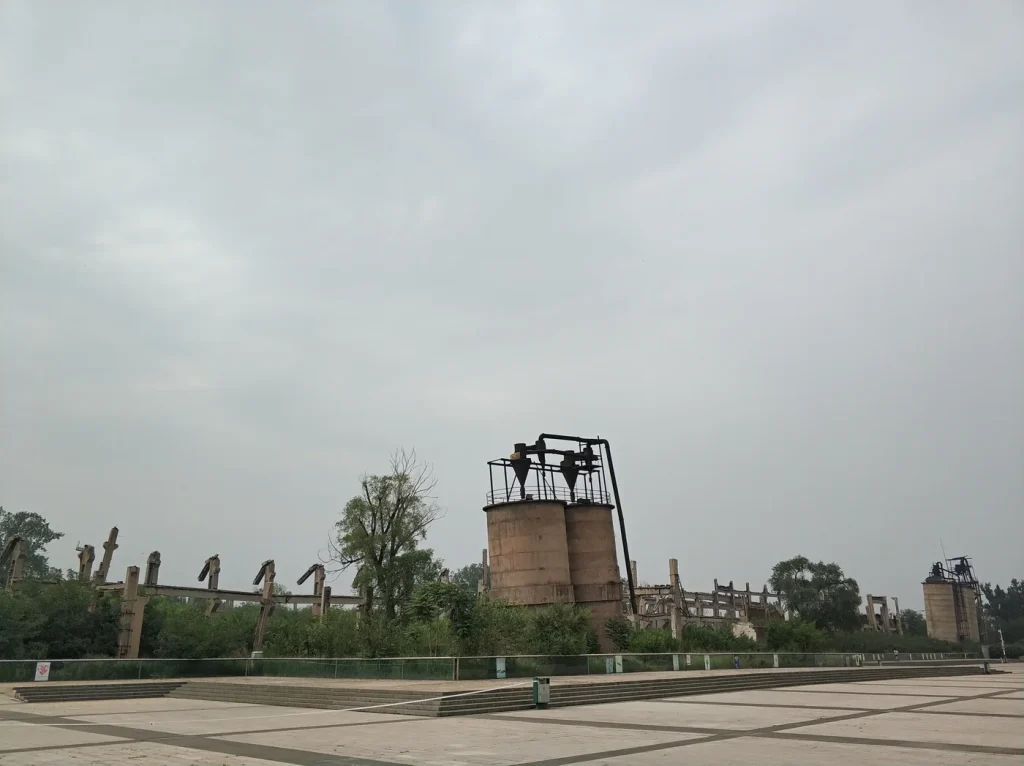
The surviving remains of the former rolling-stock works give physical context that photographs alone cannot. Broken structural elements and industrial vessels show that the site was once a working factory rather than a purpose-built monument. View the ruins only from permitted paths and platforms; unstable historic fabric is not a place to climb for a better angle.
The contrast between preserved damage and the rebuilt city around it is central to the visit. Avoid presenting the ruins as abandoned “urban exploration.” They are conserved evidence within a public memorial. If part of the ruins is screened for maintenance, respect the barrier and rely on the exhibition for closer historical interpretation.
4. Finish with the memorial exhibition hall
Ending indoors can help organize what you have seen outside. The Hebei Provincial Cultural Heritage Administration describes the museum as part of a 40-hectare park divided into ruins, plaza, water and memorial-forest areas. Earlier official descriptions cover photographs, objects, reconstructed scenes, earthquake science and disaster-prevention education; the 2026 trial-opening notice specifically refers to the renewed memorial exhibition hall.
Exhibition content can be emotionally difficult. Allow children and other members of your group to move at their own pace. Follow the one-way visitor route where marked, keep voices low, and do not photograph objects or testimony where photography is restricted. Translation software can help with labels, but avoid holding up groups while scanning every panel.
How this differs from the downtown memorial hall
The downtown Tangshan Anti-earthquake Memorial Hall was founded in the 1980s and stands near the earthquake memorial monument. A February 2026 opening notice for that institution described free admission with valid identification and different seasonal last-entry times. Those details do not apply automatically to the museum inside the memorial park.
If you have only half a day, choose the memorial park for the combination of names, ruins and museum on one site. Add the downtown hall only if you have enough emotional and practical time; seeing both back-to-back can be demanding. If your main goal is a broader city route, use our Tangshan one-day itinerary to balance remembrance with a later stop in the rebuilt city.
Getting there and planning the rest of the day
The park is south of central Tangshan in Lunan District. From Tangshan railway station or a city hotel, a licensed taxi or app-booked car is usually simpler for a visitor who does not read Chinese. Save the Chinese destination, screenshot the return address and agree on a legal pickup point. Do not rely on a bus number copied from an old guide without checking the live route.
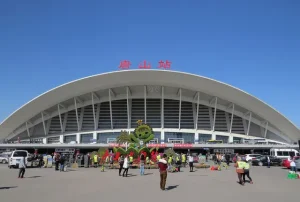
For the intercity journey, the Beijing–Tangshan train guide explains station choice and time buffers. Keep the memorial visit well clear of your return train: security screening, traffic and capacity control can all add time. An early or mid-morning arrival gives you more room than targeting the final admission window.
After the memorial park, choose a genuine change of pace. Nanhu Park shows another side of Tangshan’s urban transformation, while the Kailuan National Mine Park guide covers industrial history from a different perspective. Do not force all three into one short day; travel time and museum fatigue matter.
Photography, accessibility and visitor conduct
The three images in this guide are real photographs taken in July 2019, before the 2026 exhibition renewal. They accurately depict major outdoor elements but do not show today’s crowd levels, barriers or museum interior. Each image has a traceable source and license below it, and none duplicates an image used in the existing Tangshan day-trip article.
For photography, prioritize context: the entrance plaza, the length of the wall and the relationship between the ruins and the landscape. Avoid close photographs of grieving people without permission. Drones, tripods and commercial shoots may require separate authorization; an open park is not blanket permission.
The broad outdoor spaces may look level, but accessibility depends on the active route, distances, thresholds and exhibition arrangements. Visitors with limited mobility should ask about the nearest drop-off, wheelchair route, seating and accessible toilets before arrival. Summer sun, winter wind and long exposed walks can be tiring, so bring water and weather protection while observing rules about food and drink inside the museum.
Official and institutional references
- Tangshan Earthquake Memorial Park Management Center announcement, republished by Beijing Daily on 26 July 2026: trial opening, summer hours, free entry and capacity controls.
- Hebei Provincial Cultural Heritage Administration: Tangshan Earthquake Museum, park layout and institutional background.
- Tangshan municipal government: memorial wall and survivor context, published 30 July 2022.
- Tangshan Anti-earthquake Memorial Hall notice, used only to distinguish the separate downtown institution.
Opening details can change after publication. Verify the memorial exhibition hall and outdoor route for your intended date. Suggested visit lengths and itinerary pairings are editorial estimates.
Kailuan National Mine Park Guide: Tangshan Industrial Heritage and Underground Visits
Plan a Kailuan National Mine Park visit in Tangshan with industrial-heritage context, underground-route expectations, current-access checks, and links…
Luanzhou Ancient City Tangshan Guide: Canal Streets, Night Walks and Route Tips
Plan Luanzhou Ancient City in Tangshan with canal-street views, reconstructed old-town context, night-walk ideas, Beijing route logic, and…
Eastern Qing Tombs Guide: Zunhua Imperial Tombs, Sacred Way and Beijing Route Tips
Plan Eastern Qing Tombs in Zunhua with Qing imperial history, Sacred Way priorities, Beijing and Tangshan route tips,…
Zunhua Eastern Qing Tombs Day Trip from Beijing or Tangshan
Plan a Zunhua Eastern Qing Tombs day trip from Beijing, Tangshan or Chengde with route timing, imperial tomb…
Tangshan Nanhu Park Guide: Lake Walks, Urban Renewal and Beijing Train Tips
Plan Tangshan Nanhu Park with lake walks, urban renewal context, Beijing train links, best timing, city pairings, hotels,…
Beijing to Tangshan Train Guide: Stations, Tickets and Day Trip Planning
Plan a Beijing to Tangshan train trip with station checks, ticket tips, Tangshan day-trip ideas, Nanhu Park, the…