
Guanghui Temple Hua Pagoda Guide: Zhengding’s Flower Tower and Old-City Walk
From a distance, the Hua Pagoda looks like a pale, tapering bouquet rising above Zhengding’s rooftops. Walk closer and the apparent flowers become sculpted figures, animals and miniature architectural forms. This is the main reason to visit Guanghui Temple (广惠寺): not a long circuit of halls, but a single, unusually intricate tower that rewards a slower look.
Allow roughly 30–45 minutes for the pagoda and its setting, or about an hour if you enjoy architectural photography. Those are suggested planning allowances, not official visiting times. It makes a compact stop on the southern side of a Zhengding old-city day trip, without needing to turn the entire day into a race between towers.
Find the right tower
Save 广惠寺华塔 in your map app. English listings may use Hua Pagoda, Huata, Flower Pagoda or Guanghui Temple Pagoda. These refer to the same monument in Zhengding, near Shijiazhuang; they are not separate attractions. Check that the pin is in Zhengding’s old city before arranging a ride.
The tower is one of Zhengding’s four celebrated pagodas, but they are visually quite different. Do not confuse its sculptural crown with the closely stacked eaves of Chengling Pagoda at Linji Temple. Comparing those two makes a rewarding short architecture outing. If your time is limited, study two carefully rather than collecting hurried photographs of all four.
How old is the Hua Pagoda?
Guanghui Temple’s origins are associated with the Tang dynasty, but that does not mean every part of the standing tower is untouched Tang construction. Zhengding’s cultural authority describes the surviving architectural character as belonging to the Song–Jin period, with repairs in later dynasties. The State Council’s 1961 protected-monument list records the pagoda under the Jin dynasty.
That distinction matters when reading signs and guidebooks: the foundation history of a temple, the date of a surviving structure and the age of its repaired surfaces are different questions. For a visitor, it is more useful to notice the building’s contrasting parts than to repeat an oversimplified claim that the entire monument is a pristine, single-period original.
Three things to look for, from ground level
1. The smaller towers at the base
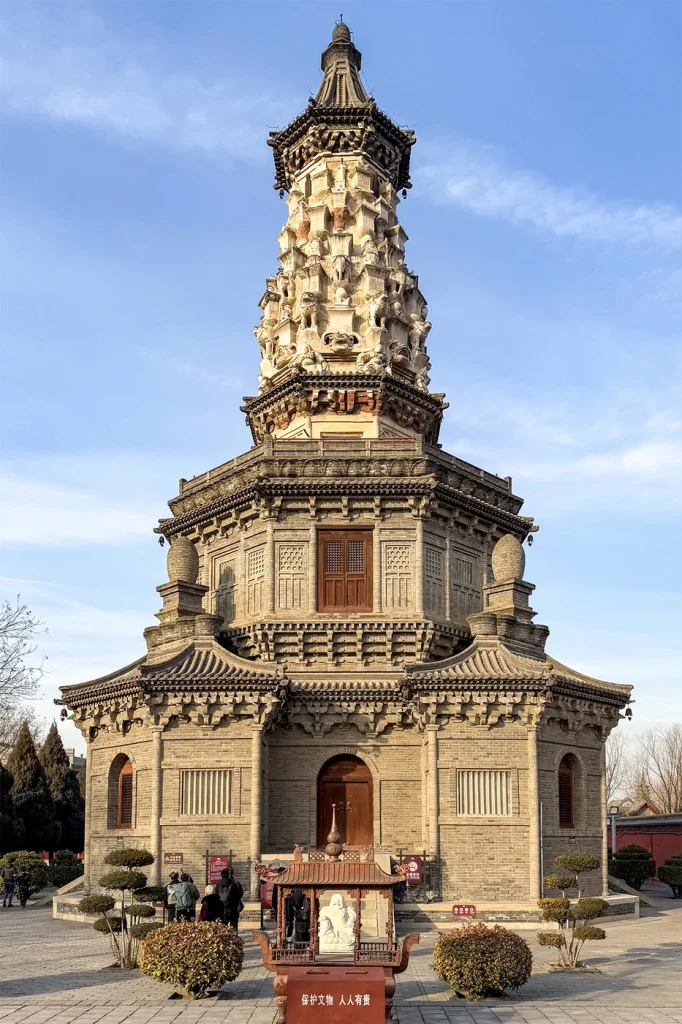
Begin far enough back to see how the central structure relates to the smaller pavilion-like corner towers. The central tower does not rise as an isolated shaft: the lower structures spread its silhouette outward. Change your position along the permitted courtyard path to see one corner separate visually from the main mass. A straight-on photograph and a slightly angled view reveal different relationships.
2. Brickwork that recalls timber construction
Look beneath the projecting eaves and around the door and window forms. Their layered brackets and framed surfaces invite comparison with wooden buildings, although this is a brick pagoda. Instead of immediately zooming to the top, trace one horizontal line around the lower section. This makes the transition to the more densely decorated upper part much easier to understand.
3. The flower-like upper section
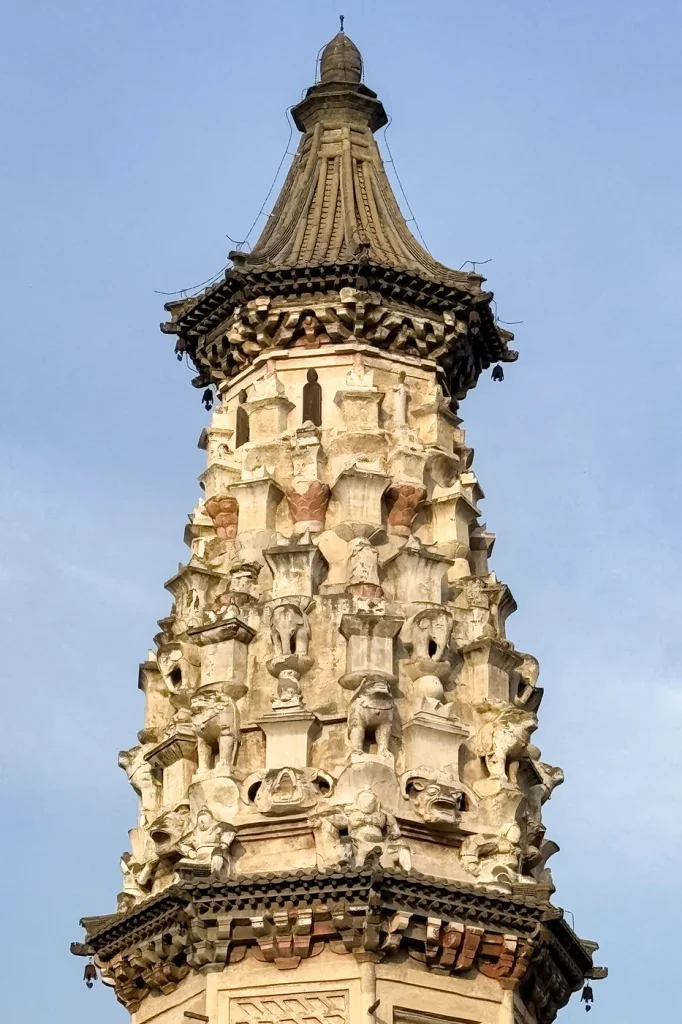
The crown is not simply a floral pattern. Official descriptions identify Buddhist figures, guardian figures and animal forms among the decoration. Some project strongly while others sit closer to the surface, producing overlapping shadows. Start by finding a large recognizable shape, then look at the smaller structures between the figures. You do not need to identify every subject to appreciate the arrangement.
From directly below, details can merge into one pale texture. A little distance and a modest optical zoom often work better than standing at the foot of the wall. Binoculars can also help. Stay on open visitor paths; do not climb onto a plinth or step over a barrier for a clearer angle.
Can you climb it, and is it open at night?
Plan this as a ground-level architecture visit, not a guaranteed tower climb. The county’s historical description mentions climbing and imperial visits, but a description of past use is not confirmation that today’s visitors can access the stairs or upper levels. Ask staff about the areas open on the day, and base your decision to visit on the exterior.
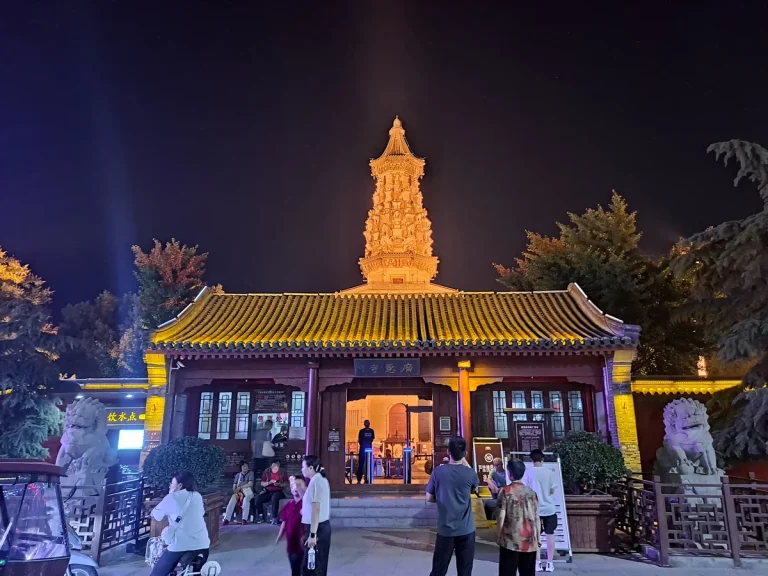
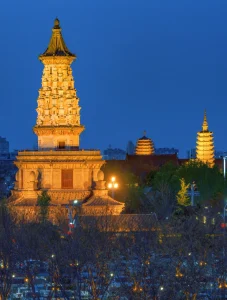
The night photograph above was taken on 8 June 2024. It documents a real illuminated scene, not a promise of nightly lighting, a current performance or unrestricted evening entry. If the carvings are your priority, visit in daylight. If you are staying for an evening stroll, confirm the temple gate’s closing time separately from the opening of surrounding streets.
Our Zhengding night-walk guide can help you build the rest of the evening without making temple admission the only reason to stay. A view from an open public street is different from access inside a ticketed or managed site.
Tickets and hours: what is verified, and what is not
Checked on 17 September 2026: a Shijiazhuang culture-and-tourism itinerary published on 5 September 2024 lists Guanghui Temple at RMB 15 with hours of 08:30–18:00. Beijing’s official tourism directory also lists RMB 15, but gives 09:00–17:00. These are dated or undated directory references, not a verified current ticket-office notice.
Because the schedules disagree, this guide does not present either as the confirmed 2026 timetable. Before travelling specifically for the tower, check the current notice at the attraction or ask your accommodation to confirm admission, last entry, evening access and any conservation restrictions. Allow a daylight visit well before the advertised closing time rather than planning around the final few minutes.
Useful questions are 今天几点停止入园? (“What time is last admission today?”), 现在可以登塔吗? (“Can visitors climb the tower now?”) and 外国护照可以现场购票吗? (“Can I buy a ticket here using a foreign passport?”). Keep your passport available where identity verification is requested. Do not assume that an old student promotion or a local annual-pass offer applies to your visit.
A relaxed southern old-city walk
The municipal tourism bureau’s published route links the old city wall, Guanghui Temple, Yanghe Tower and Kaiyuan Temple. Use that as a geographical framework, not a requirement to enter every attraction. For a manageable outing, allow roughly two to three hours for a few selected stops, street walking and a break; this is our estimate and excludes the journey from your hotel.
- Start around the southern city wall. Establish your bearings and check which sections are open. Do not assume a wall-top circuit is continuous or that every staircase is accessible.
- Give Hua Pagoda a dedicated stop. Spend the first few minutes on the full outline, then move to the lower brick details and finally the sculptural crown. Read the site interpretation before moving on.
- Continue toward Yanghe Tower. Let the walk include ordinary street scenes and a drink stop. Follow current pedestrian arrangements rather than navigating across traffic for a photograph.
- Add Kaiyuan Temple only if you still want more architecture. Otherwise, stop for a meal or return to another part of the old city. A shorter route with time to look is better than arriving at the next gate just as it closes.
For a more substantial temple interior and collection of Buddhist architecture, give Longxing Temple its own generous time block. Hua Pagoda is a focused addition, not a substitute for that larger visit. For lunch, the Zhengding food guide explains local dishes so you can choose a meal rather than simply the nearest queue.
Getting there from Shijiazhuang
Save both the attraction pin and your return address before setting out. For a taxi or app-booked car, use the full Chinese name and agree on a legal pickup point nearby. A parking-area name may be more practical than asking a driver to stop at a busy pedestrian entrance, but confirm the exact meeting point in the app.
Rail arrival still involves a transfer to the old city. Check the full station name on your ticket rather than treating Shijiazhuang, Zhengding and Zhengding Airport stations as interchangeable. The Beijing–Shijiazhuang rail guide covers the broader journey; leave a separate buffer for road traffic and station security on the return trip. No unverified bus number or fixed taxi fare is quoted here.
Photography, comfort and respectful access
The three photographs on this page are distinct, real images, individually credited below each picture. The two daylight views date from January 2025. They show the tower’s form and detail, not today’s barriers, weather or maintenance conditions.
For a useful set of your own pictures, try one overall view, one lower-level detail and one closer view of the crown. Do not block a doorway while checking your shots. Keep clear of religious offerings and follow restrictions on tripods, drones or interior photography; an outdoor setting is not blanket permission to fly a drone.
People with limited mobility should ask about the route from drop-off to the courtyard, thresholds and any available step-free access. Do not infer accessibility from a distant photograph. Bring sun protection for exposed areas and shoes suitable for uneven paving. If conditions make lingering uncomfortable, keep the tower stop short and take a break before continuing through town.
Sources and planning notes
- Zhengding cultural authority: Hua Pagoda history and architectural features, published 2 September 2019.
- State Council Gazette: 1961 protected-monument list, including Guanghui Temple Hua Pagoda.
- Beijing official tourism directory: Guanghui Temple, background and directory-level visitor information.
- Shijiazhuang tourism bureau: Zhengding two-day route, published 5 September 2024; historical ticket and opening-hour reference.
Route pacing and photographic suggestions are editorial recommendations. Check current opening arrangements before departure. The licenses linked in the photo captions apply to those images, including the resized WebP versions.
Chengling Pagoda Zhengding Guide: Linji Temple, Zen Heritage and Jin-Era Architecture
Visit Chengling Pagoda at Linji Temple in Zhengding with accurate history, architectural details, real photos, respectful planning, and…
Longxing Temple History: Zhengding Buddhist Architecture and Heritage
Understand Longxing Temple in Zhengding through Buddhist architecture, sculpture, heritage layers, old-city context, and how to view the…
Zhengding Ancient City Guide: Temples, Towers and Old Streets
Decide how to visit Zhengding Ancient City near Shijiazhuang, including Longxing Temple, old streets, food, night walks, travel…
Zhengding One-Day Itinerary from Shijiazhuang: Temples and Old City
Use this Zhengding one-day itinerary from Shijiazhuang to plan Longxing Temple, old streets, local food, towers, night walk…
Longxing Temple Zhengding Travel Guide: Route, Highlights and Tips
Plan a Longxing Temple visit in Zhengding with route order, time budget, transport checks, food pairing, and practical…

Zhengding Ancient City Night Walk Guide: Lights, Food and Old Streets
Plan a focused evening walk in Zhengding Ancient City with city-wall views, old streets, food stops, night-event checks,…