
Rongguo Mansion Zhengding Guide: Dream of Red Mansions Filming Set
Rongguo Mansion gives Zhengding a different kind of historic visit. Its courtyards, ceremonial halls and garden were built for the television adaptation of Dream of Red Mansions, one of China’s best-known novels. The site feels like a large traditional household, but it is an 1980s filming set, not an original Qing dynasty residence of the fictional Jia family. Understanding that distinction makes the architecture and the town’s modern tourism history more interesting.
The Chinese name is 荣国府 (Rongguo Fu). You do not need to have read the novel to enjoy the visit. Treat it as a walk through a carefully staged idea of a wealthy household, with the story of how a county near Shijiazhuang became an important screen location. Give yourself roughly 90 minutes to two hours for an unhurried look around; that is a planning estimate, not an official visit duration.
Why is a fictional mansion in Zhengding?
When China Central Television prepared its 1987 television adaptation of Dream of Red Mansions, Zhengding helped create a permanent outdoor setting instead of a temporary facade. Shijiazhuang’s municipal government dates construction to late 1984 and opening to July 1986. Production used the site for major scenes, and the completed complex then continued as a visitor attraction and filming location for later productions.
The novel’s mansion belongs to the Jia family, whose wealth, relationships and decline drive much of the story. Here, architecture helps make that world legible: formal entrances lead to more private courtyards, decorated rooms signal status, and gardens provide a change of pace. These are interpretive settings designed for a screen production. Do not read a painted beam or a displayed chair as proof that a particular eighteenth-century household owned it.
A walk through the mansion
Begin at the gate and follow the courtyard sequence
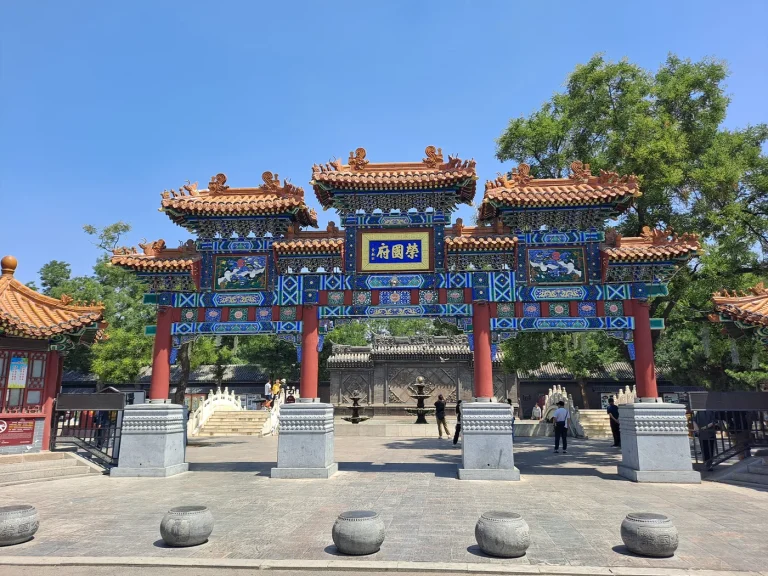
Pause at the entrance archway before going in. Its color and elaborate roofline establish the theatrical scale of the place. Once inside, use the posted map to see which courtyard route is open that day. Municipal descriptions divide the mansion into eastern, central and western sequences of linked courtyards. A side gate may look like the main axis from a photograph, so the on-site signs are more useful than trying to copy a social-media route exactly.
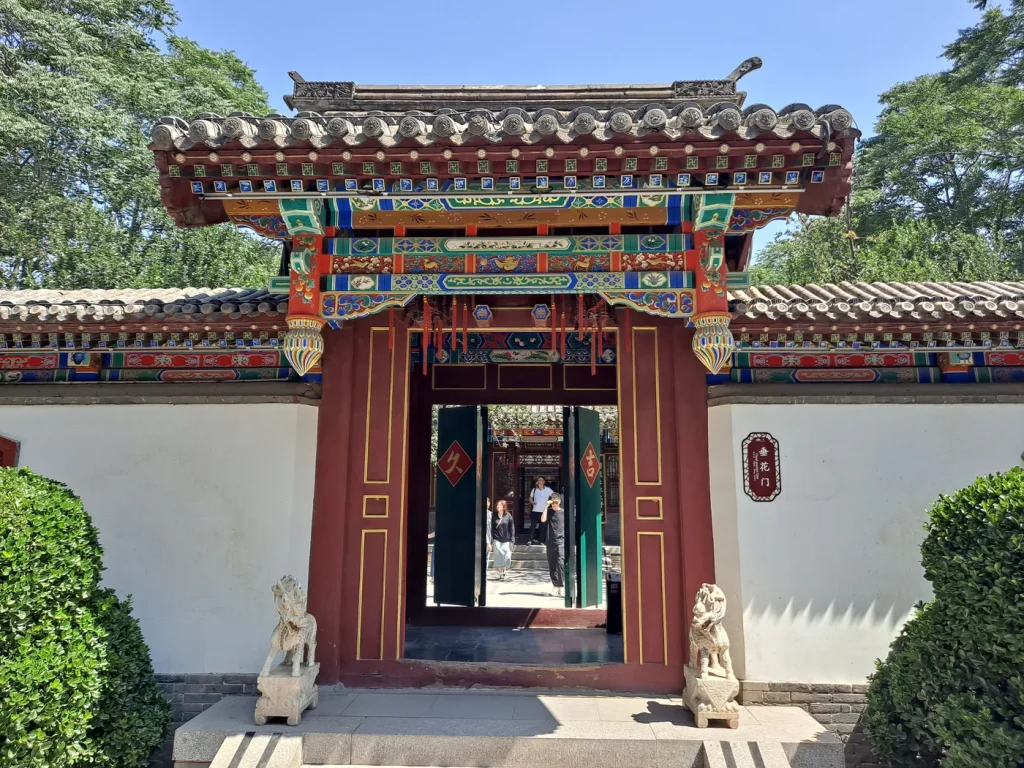
The chuihua gate in the next photograph is one example of the transition between spaces. Look at the painted underside and the way the opening frames another courtyard. The small changes between gates, covered walks and open yards give the complex its rhythm; a fast walk to one famous hall misses much of the design.
Look closely at the ceremonial rooms
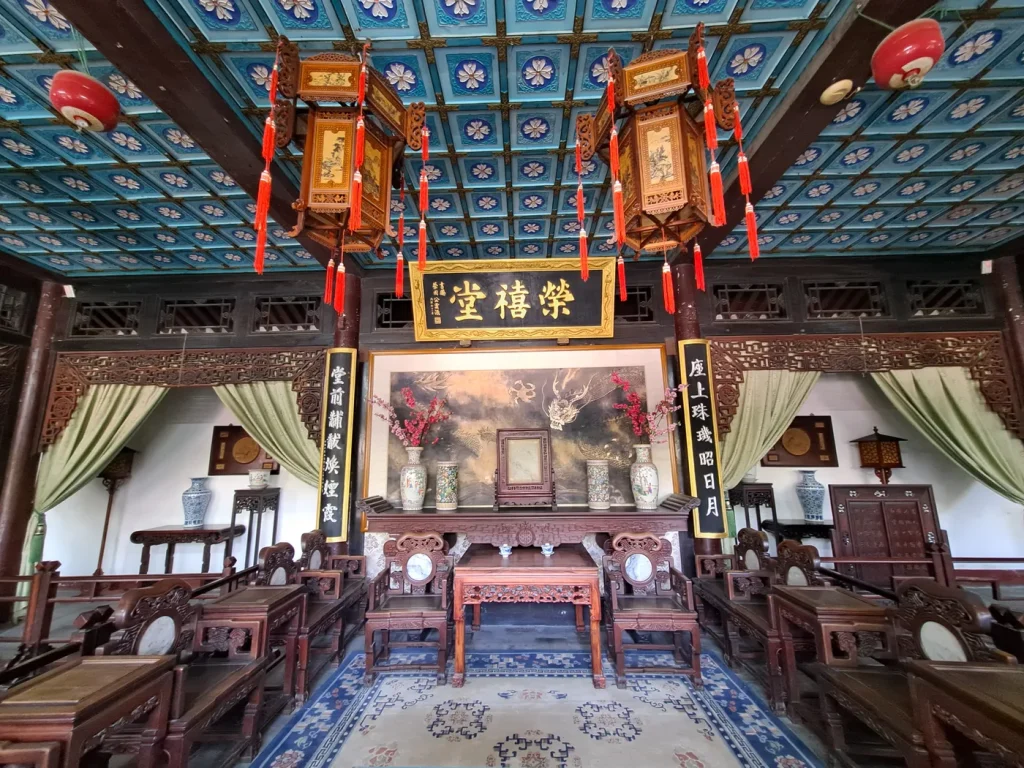
Rongxi Hall (荣禧堂) is a useful stop for studying how furnishing and surface decoration work together. Its plaque, lanterns, painted ceiling and arranged seats build an image of status. Interior displays are subject to change, and some rooms may be viewed only from a doorway or behind a barrier. Respect those limits and check local photography rules before using a flash or tripod.
Readers of the novel may recognize more room names than first-time visitors. You do not need to invent a one-to-one correspondence between every room and a scene. Read the labels that are present, then notice the practical filmmaking choices: connected passages let a production move between spaces, while a richly furnished interior gives a convincing background without being a surviving aristocratic house.
Leave time for the garden
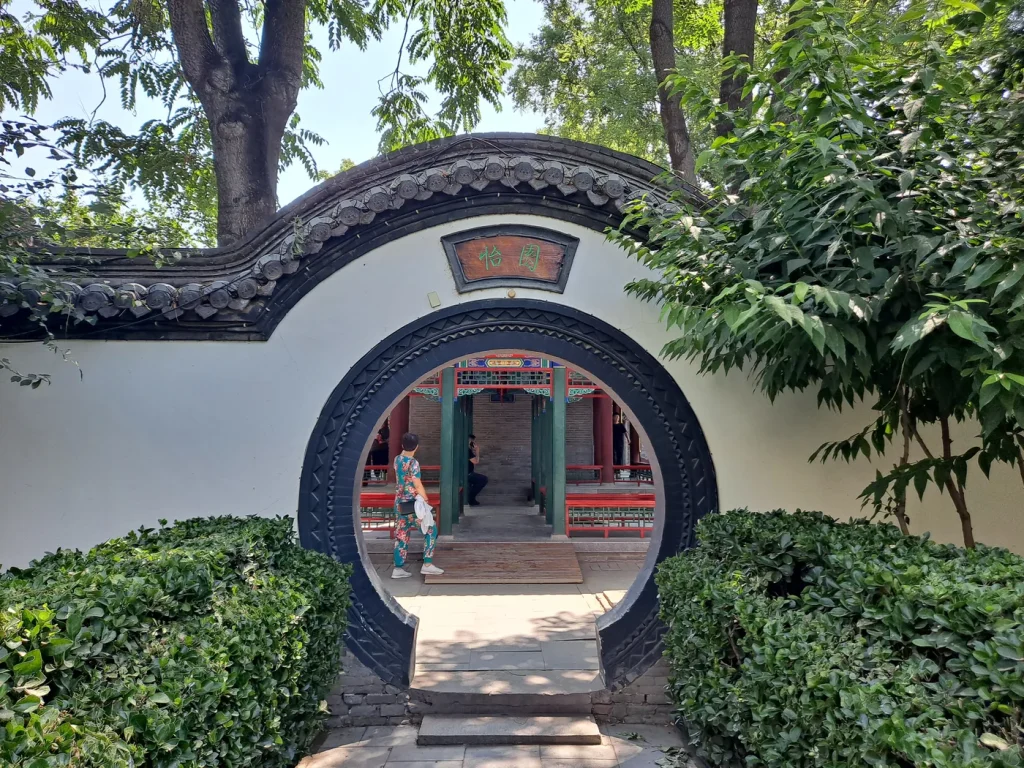
Yi Garden (怡园) breaks up the sequence of halls with trees, shaded paths and a moon gate. It is especially useful if you have been concentrating on dense room displays. The round opening frames another layer of the garden, giving you a photograph with a clear sense of depth. Wait for people to pass rather than stepping into planted areas for a cleaner shot.
Finish on Ningrong Street
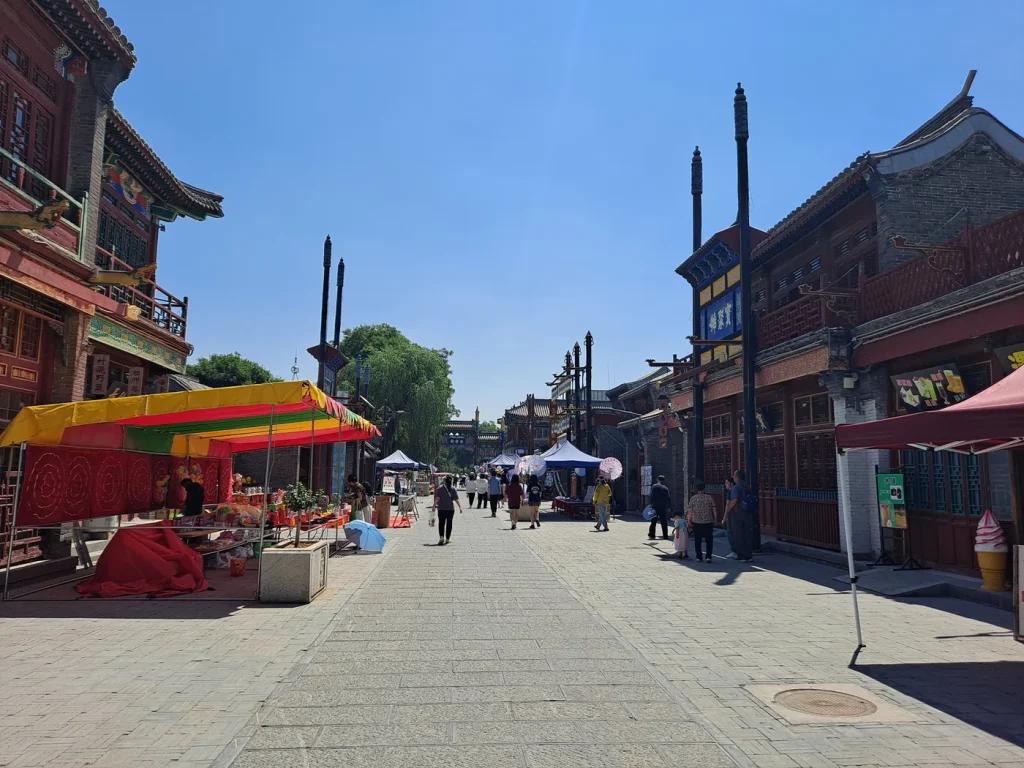
Municipal information describes Ningrong Street (宁荣街) as part of the wider Rongguo Mansion project, modelled as a period shopping street. It now works as a public-facing visitor space with shops and changing activity. The 2024 photograph below shows an ordinary daytime street, not a guarantee that any particular stall or performance will be there when you visit. Confirm the present route, ticket boundary and opening hours on site if you intend to spend time on both the mansion and the street.
Shows and evening visits: check the date
Hebei’s culture and tourism department reported a daytime Honglou Youxi program launched in July 2026 and an earlier immersive evening experience called Yi Meng Ru Honglou. These are programmed events rather than permanent features of every entrance ticket. Performances, start times, language support and night admission can change for weekdays, holidays and seasons. Check the attraction’s current official notice before arranging a late return journey around a show.
If you mainly want to understand the 1987 adaptation, a daylight visit makes it easier to study the rooms and the relation between courtyards. Evening programs may add atmosphere and performers, but low light and crowds can make architectural details harder to see. Pick the visit that suits your interest instead of assuming one ticket covers both.
Getting there and building a Zhengding day
Save 正定荣国府 in a map app and check the actual entrance pin. Zhengding is north of central Shijiazhuang, but the scenic area is not at a railway platform. Check which station your train uses and allow a separate local transfer; our Beijing to Shijiazhuang train guide covers the rail-planning side of the trip.
For a first-time visit, combine Rongguo Mansion with one or two other old-city stops. Longxing Temple offers actual historic Buddhist architecture and sculpture, a valuable contrast with this modern screen set. Guanghui Temple’s Hua Pagoda is another distinct heritage stop. Our Zhengding evening walk can help you decide what to leave until after dark.
Food can make the day less hurried. If you want to try a regional meal instead of another attraction, see our Zhengding Eight Bowls guide. Leave time to return to the correct station; Shijiazhuang, Shijiazhuang East and Zhengding Airport station are different places.
Tickets, access and realistic expectations
Checked 23 September 2026: government sources confirm the site’s history and describe recent performances, but they do not establish a reliable same-day price, opening window or complete show schedule. Verify these details with the attraction shortly before travelling. During filming, rehearsals or special events, a courtyard or hall can be temporarily unavailable.
Most of the experience is a sequence of paved yards, gates and rooms. Door thresholds, steps and crowded passages still matter for visitors with limited mobility. Ask staff which route is accessible that day. In summer, the open courtyards can be hot while some corridors are shaded; carry water. On busy weekends, wait for space around room displays and let others read the signs.
The five images here are real on-site photographs taken in June 2024. They document the entrance, an inner gate, Rongxi Hall, Yi Garden and Ningrong Street. They cannot prove the present condition of a room, shop or performance. Each caption links to its source and public-domain declaration; no AI-generated picture is presented as a destination photograph.
Sources and further checks
- Shijiazhuang Municipal Government: construction dates, layout, Ningrong Street and filming history.
- Hebei Department of Culture and Tourism: 2026 daytime performance and Zhengding cultural route reporting.
- Hebei Department of Culture and Tourism: the evening immersive program in its 2025 version.
- Chinese People’s Political Consultative Conference: the set’s development and role in Zhengding tourism.
Confirm today’s admission, room access and event times before departure. Walking times and suggested pairings in this guide are editorial planning estimates.
Zhengding Ancient City Night Walk Guide: Lights, Food and Old Streets
Plan a focused evening walk in Zhengding Ancient City with city-wall views, old streets, food stops, night-event checks,…

Zhengding Eight Bowls Guide: What to Order and How to Plan the Meal
Learn how to try Zhengding Eight Bowls, what the shared banquet means, how to order it, and how…

Majia Chicken Guide: Zhengding Braised Chicken and Food Trip Tips
Plan how to try Majia Chicken in Zhengding, what the braised chicken tastes like, when to eat it,…
Zhengding Food Guide: Ancient City Snacks, Majia Chicken and Eight Bowls
Use this Zhengding food guide to plan ancient city snacks, Majia Chicken, Eight Bowls, night-market checks, and a…
Guanghui Temple Hua Pagoda Guide: Zhengding’s Flower Tower and Old-City Walk
Look closely at Zhengding's Hua Pagoda: sculpted figures, corner towers and brick details, with a relaxed old-city route…
Chengling Pagoda Zhengding Guide: Linji Temple, Zen Heritage and Jin-Era Architecture
Visit Chengling Pagoda at Linji Temple in Zhengding with accurate history, architectural details, real photos, respectful planning, and…