
Cangzhou Museum Guide: Grand Canal, Acrobatics and Local History
Cangzhou Museum is a good first stop if the city’s iron lion, Grand Canal and acrobatics sound like unrelated attractions. Inside one building, the exhibits put those stories on the same map. A visitor can start with archaeological objects and local history, then move to canal culture, martial arts and Wuqiao performance traditions. It is a very different Cangzhou visit from a show or an outdoor monument: the pleasure is in making connections between places you might visit later.
The museum’s Chinese name is 沧州市博物馆. This guide follows the museum’s own visitor information, checked on 29 September 2026. Exhibition rooms, objects on display and temporary closures can change, so use the current museum notice rather than treating any photograph here as a live view of a gallery.
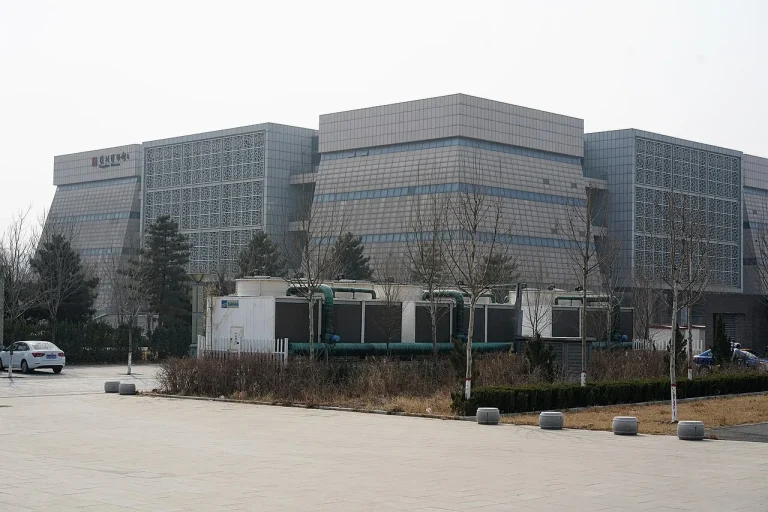
What is worth seeing inside?
The museum’s published floor guide lists local history and folk culture on the second floor, with Grand Canal, acrobatics and martial-arts displays on the third. The first floor includes changing exhibitions and experience spaces. This is a practical way to choose a route, not a promise that every named hall will be open on your date. At the entrance, check the day’s floor map and any closures before going upstairs.
Start with the history of Cangzhou
Canghai zhi Zhou (沧海之州) is the museum’s local-history exhibition. Instead of trying to memorize every dynasty, look for how geography shaped the city: a coastal plain, rivers and transport routes created connections inland and toward the Bohai Sea. Material from nearby counties also belongs to this regional story. A label that names Xian or Yanshan County does not mean you are in the wrong museum; it shows the collection’s wider Cangzhou context.
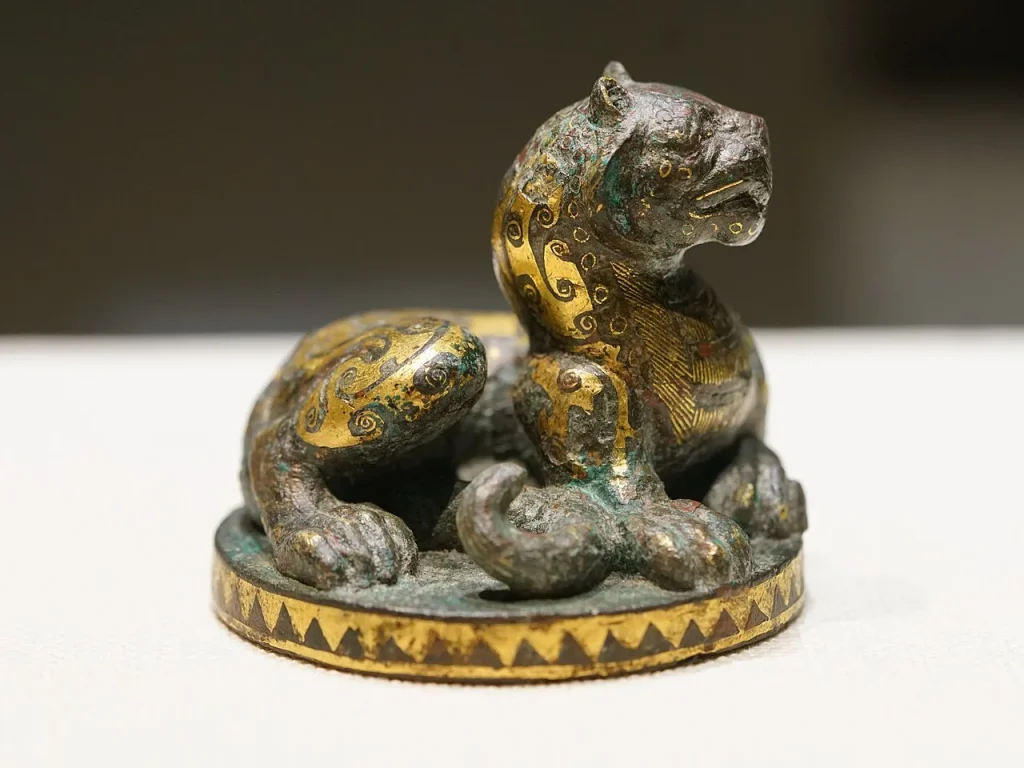
One small object rewards a slow look: the gold-inlaid leopard-shaped seat weight (错金豹镇). The museum describes it in its history gallery and explains that such weights helped hold down the corners of a floor mat. It reports the object was found in 1968 in Xian County; the photo’s Commons description attributes it to the Xian County cultural-relics collection. Notice the leopard’s compact pose and the surviving gold pattern. This is not a miniature statue made for a modern desk, and the historical owner of the object should not be presented as certain.
Connect the Grand Canal to ordinary life
On the museum’s published third-floor route, Da Yunhe Bei (大运河北) covers the Hebei section of the Grand Canal. Think beyond a single waterway photograph. Canal travel affected the movement of food, manufactured goods, people and ideas; a city museum can show how these larger networks reached Cangzhou and its counties. Read the local place names on maps and labels, then compare them with the actual urban canal corridor when you go outside.
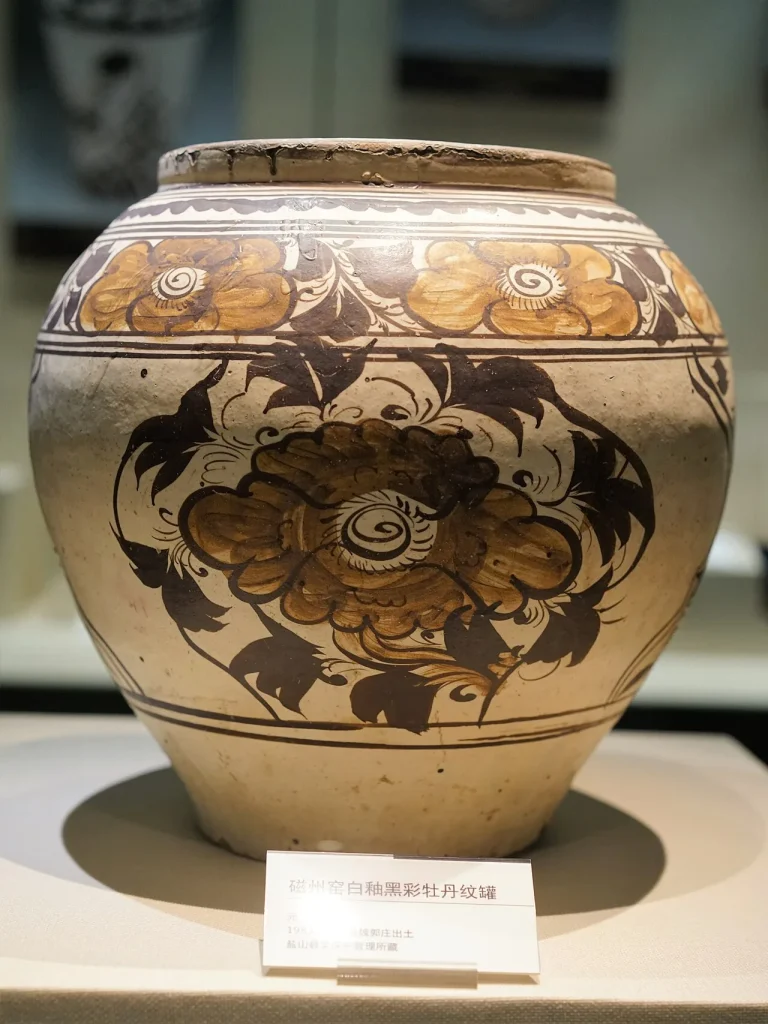
The black-painted Cizhou-ware jar below was photographed among the museum collections. Its Commons description identifies a find from Yanshan County in 1983. The peony decoration is visually striking, but the photograph alone does not establish its exact firing date, trading route or current display case. Use the gallery label for those details. The object is a useful reminder that a Cangzhou museum visit is about regional material culture, not only the canal itself.
See why Wuqiao acrobatics belongs in the story
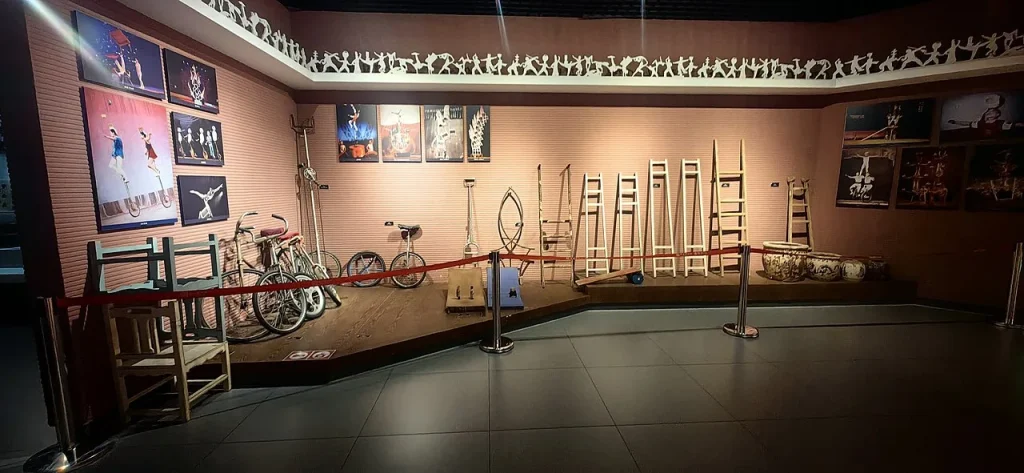
The museum lists Baixi zhi Yuan (百戏之源), an exhibition on Cangzhou acrobatics. Wuqiao County, within the Cangzhou area, is closely associated with this performance tradition. The real display photograph below shows props rather than a live act. Looking at the equipment can make the physical practice behind a stage performance more tangible, but do not expect museum display cases to substitute for a scheduled show.
If seeing acrobats perform is your main aim, plan Wuqiao Acrobatics World as a separate outing and verify its current program. The museum offers context; Wuqiao offers a visitor-facing performance setting. They are in different parts of the Cangzhou area, so do not assume you can casually walk between them or fit both into a short city stop.
Leave room for the other galleries
The official floor guide also names exhibitions on martial arts, coastal resources, Cangzhou folk customs, local figures and traditional Chinese medicine. You do not have to cover every room. A focused visit to the history, canal and acrobatics galleries can be more memorable than a hurried circuit of the building. Temporary exhibitions may be the most timely reason to extend your visit, so check the museum’s current announcements on arrival.
Tickets, opening hours and language
The museum’s current published visitor guide gives its usual hours as Tuesday to Sunday, 9:00-17:00, with last admission at 16:30; it says Mondays are normally closed except statutory holidays. It also describes real-name reservation through the museum’s WeChat account or on-site same-day reservation, subject to capacity. These rules are changeable. The museum has posted temporary closure notices in 2026, so check its latest announcements shortly before departure, especially around holidays or bad weather.
For an international visitor, the key uncertainty is how the reservation system accepts your identity document. The published guide does not clearly explain a foreign-passport workflow. Do not assume a Chinese ID number is required or that a passport will work in every online form. If the WeChat flow fails, ask the museum directly about its on-site ticket window and accepted documents before making a special journey. Its visitor guide lists a consultation number, 0317-2130069, though English-language assistance is not guaranteed.
Look for 沧州市博物馆 in your map app. The museum’s own visitor page gives 59 Yuhe Road, Yunhe District, Cangzhou and lists bus routes 16 and 232 at the museum stop. Verify the entrance pin and current bus service locally. The visitor information mentions self-guided and digital interpretation, but do not count on full English labels or an English tour without checking ahead.
How to fit the museum into a Cangzhou trip
Allow roughly 90 minutes to two hours for a selective visit, or more if a temporary exhibition interests you. That is an editorial planning estimate, not an official timed route. Start with the museum while the galleries are open, then use the afternoon or evening for Nanchuan Old Street and the canal-side area. You will have more context for the city’s waterway story after seeing the maps and objects inside.
For a different type of heritage, compare the museum’s collections with the outdoor Cangzhou Iron Lion. It is not next door: allow for a separate transfer and check its own visitor conditions. Our Beijing-Cangzhou train guide helps distinguish stations before you buy a ticket. Cangzhou city, Xian County and Wuqiao County are distinct locations; a museum label can connect their histories without making them one compact walking itinerary.
Photographs, sources and final checks
The four images in this guide are actual photographs of the museum exterior or displays, taken in 2019 and 2026. They have been resized and converted to WebP, not generated. Each caption links to its original Commons file, credits the photographer and identifies the CC BY-SA 4.0 license. A photographed artifact may be owned by a county collection or moved between displays; confirm what is on view when you visit.
- Cangzhou Museum visitor guide: usual hours, reservation guidance, address and published floor plan.
- Cangzhou Museum research note on the leopard seat weight: object details and discovery context.
- Cangzhou Museum announcements: the place to confirm temporary closures and holiday arrangements.
Before you travel: confirm that the museum is open, how to reserve with your document, which galleries are accessible and whether any special exhibition has separate rules.
Cangzhou Nanchuan Old Street Guide: Grand Canal Walks, Food and Night Views
Plan an evening and morning around Cangzhou Nanchuan Old Street, with Grand Canal views, heritage context, food stops…
Wuqiao Acrobatics Guide: Cangzhou Acrobatics World, Shows and Day Trip Tips
Plan a Wuqiao Acrobatics trip in Cangzhou with Wuqiao Acrobatics World, show priorities, culture context, Beijing train logic,…
Cangzhou Iron Lion Guide: History, Photos and Grand Canal Day Trip Tips
Plan a Cangzhou Iron Lion visit with history, photo tips, Grand Canal links, Beijing train planning, old-city route…
Cangzhou Day Trip: Iron Lion, Grand Canal and Old City Culture
Plan a Cangzhou day trip around the Iron Lion, Grand Canal context, local culture, city food, transport timing,…
Beijing to Cangzhou Train Guide: Stations, Iron Lion and Grand Canal Tips
Plan a Beijing to Cangzhou train trip with station choices, Iron Lion, Grand Canal context, city transfers and…
Shengfang Ancient Town Guide: Bazhou Water-Town Walks, Wenchang Pavilion and Folk Culture
Plan Shengfang Ancient Town in Bazhou with water-town context, Wenchang Pavilion and old-street walking ideas, museum stops, and…